Showing posts with label China. Show all posts

Leadership of Google's Dragonfly Project

Thursday, 13 December 2018

Earlier this week, Google CEO Sundar Pichai made his first ever appearance in US Congress and faced criticism from lawmakers over the company's plan to launch as censored search engine in China. Pichai was evasive on several questions about the project, known as Dragonfly, and declined to answer when probed on the leadership personnel at the company involved in it.

While working on a series of stories about the search engine over the last few months, I pieced together a chart to map out the organisational structure of Dragonfly, which I am publishing here today to shine light on the key players behind the plan. The chart is a work in progress; it's not comprehensive and it is not based on any official Google documents. It is based on reliable information that multiple well-placed sources have shared with me.

In total, only approximately 300 Google employees -- 0.35% of the company's 88,000 total staff -- have worked on the censored search engine, which was designed to blacklist broad categories of information about human rights, democracy, and peaceful protest. The search platform would also link Chinese users’ search records to their cellphone numbers and share people’s search histories with a Chinese partner company — meaning that Chinese security agencies, which routinely target activists and critics, could obtain the data.

As I reported in late November, the secrecy that surrounded the China plan was unprecedented inside the company. The top executives at the internet giant went to extraordinary lengths to keep the project under wraps. But who are those executives and what are their roles within the company?

Board of directors
It is still unclear to me how much the directors -- with the exception of CEO Sundar Pichai -- knew about Dragonfly and when. The project has been underway inside Google since 2016, but co-founder Sergey Brin claimed that he knew nothing about it until we exposed the plan at The Intercept in August. Brin has in the past taken a strong anti-censorship stance, and Google sources have suggested to me that some executives (see Scott Beaumont, below) may have deliberately withheld information from him about Dragonfly. I know for sure that other members of the board were looped in on Google's general work in China (such as projects to push out a translate app for the Chinese market, and a $550 million investment in the online Chinese retailer JD.com). But the extent of their knowledge on Dragonfly, and how much of it they signed off on -- I am still trying to establish that.

Sundar Pichai, CEO:
Pichai took over at the helm of Google in 2015 and one of the items at the top of his agenda was -- and still is -- getting back into China. He publicly declared in 2016: "We want to be in China serving Chinese users.” Following the Dragonfly revelations, Pichai has faced a torrent of criticism over the censored search engine. He has defended the plan while making a series of misleading statements about how advanced the project was inside the company. Pichai appears to have delegated authority to Scott Beaumont, Google's chief in China, to manage the project.

Scott Beaumont, vice president of Google, Greater China & Korea
Beaumont is a British citizen who began his career working for an investment bank in England. He joined Google in 2009, working from London as director of the company’s partnerships in Europe, Asia and the Middle East. In 2013, Beaumont relocated to China to head Google’s operations there. He is a leading force inside the company directing the Dragonfly project, viewing it as an integral step for the growth of the company and liaising directly with CEO Sundar Pichai on the progress of the plan. Beaumont's handling of Dragonfly has caused internal friction -- Yonatan Zunger, who was until last year one of Google's leading engineers, told me Beaumont did not take seriously human rights concerns that were repeatedly raised internally about the censored search engine. Beaumont “wanted the privacy review [of Dragonfly] to be pro forma and thought it should defer entirely to his views of what the product ought to be," said Zunger. "He did not feel that the security, privacy, and legal teams should be able to question his product decisions, and maintained an openly adversarial relationship with them — quite outside the Google norm.”

Kent Walker, senior vice president of global affairs
Walker oversees Google's policy, legal, trust and safety, and corporate philanthropy teams, and formely served as the company's general counsel. His day-to-day involvement in Dragonfly appears to have been fairly limited, but he has been involved in a number of high-level meetings about the project and its policy and legal status with other top executives, including Pichai and Beaumont. Following the public exposure of Dragonfly, Walker helped handle the backlash that ensued. In October, he wrote a letter to human rights groups defending Google's mission to provide "access to information to people around the world," while claiming the company remains committed to "protecting the rights to freedom of expression and privacy for our users globally."

Caesar Sengupta, vice president, Next Billion Users Team
Sengupta leads Google's effort to "engage the next billion internet users," and has had a leadership role on the Dragonfly project, collaborating closely with Scott Beaumont. One source who worked on Dragonfly told me: "Scott tends to treat Caesar like a lackey. Scott definitely considers himself in charge and Caesar is there to do his bidding." In November, after I reported that Google's privacy and security teams had been shut out of key meetings on Dragonfly and had felt sidelined by Beaumont, Sengupta claimed on Twitter that there was "no sidelining of privacy and security" and described Beaumont glowingly as "a person of very high integrity." Sengupta stated that he had experience "working on Dragonfly", but did not mention that he had a leading role on the project.

Andrew Bowers, senior director, project management
Bowers began his career at Google in 2006 as a marketing manager, based out of California. In 2016, he relocated to China as the company began to ramp up its operations in the country. His remit is to "reintroduce Google as a brand" to people in China, doing so through various products, such as a translate app and a WeChat game designed specifically for the Chinese market. Working out of Google offices in Hong Kong, Shanghai, and Beijing, Bowers is a key player on the Dragonfly project. He has helped manage the day-to-day operations of Dragonfly and has helped to develop strategy for the launch.

Ben Gomes, head of search
Gomes joined Google in 1999 and is one of the key engineers behind the company’s search engine. He took over the role as Google's head of search in April this year, succeeding John Giannandrea in that role. Giannandrea had helped develop the Dragonfly project before he left Google to take up a new job with Apple. Gomes inherited the blueprint for Dragonfly that Giannandrea had worked on. In July, Gomes told staff in a private meeting that the censored search engine project was "extremely important to the company," and said he hoped it could be launched between January and April 2019 or sooner. “We have to be focused on what we want to enable,” Gomes said. “And then when the opening happens, we are ready for it.”

Product managers
Have been looking at studies profiling the kinds of people that might use Google search in China.

Ranking teams
Working to finely tune the quality of the search results on the censored search engine.

One Box teams
These teams have been localising Google's search results to China, so that when people perform searches for certain phrases they will receive, for example, a separate box displaying information about weather, sports results, or news (see examples of 'one box' results here). Notably, sources have said that the weather results -- specifically, air quality data -- will be provided from a source in Beijing, meaning it could be distorted to downplay toxins in the air. (The Chinese government has a track record of manipulating air quality data.) News results will also be heavily censored and they will not include content from many western outlets -- for example, the BBC, New York Times, or Wall Street Journal.

Infrastructure teams
Developing the systems that will run the search engine, host and process the data.

User experience teams
Studying Chinese people's search behaviour and looking at how they might use Google.

Security, privacy, legal teams
Fairly self explanatory: these teams have focused on security, privacy, and legal issues around Dragonfly. But their work has not been straightforward, and sources said their efforts to carry out reviews of the censored search engine was hindered by Scott Beaumont, who handled the project in a "highly unusual" way and opposed the privacy review process (you can read more details on that here).

Designers
Developing the mobile apps for the censored search engine. There are two versions, named Longfei and Maotai. Sources say Google is working on designing the app for both Android and iOS devices.

Ads, Geo, and Identity
Teams working on advertising, Google maps, and identity, respectively. The identity team focuses on user sign-in and authentication issues. The Dragonfly search app will force people in China to log in to perform searches and will link their search records to their mobile phone number.

--

If you know more about the leadership structure of Dragonfly, you can contact me securely using one of the methods detailed on this page.

Google China Censored Search Coverage

Thursday, 16 August 2018

My reporting so far on the Google-China censorship story (from oldest to newest):

Google Plans to Launch Censored Search Engine in China, Leaked Documents Reveal (1 August)

Google Struggles to Contain Employee Uproar Over China Censorship Plans (3 August)

Lawmakers Pressure Google Over “Deeply Troubling” China Censorship Project (4 August)

Inside Google’s Effort to Develop a Censored Search Engine in China (8 August)

Questions for Google on China Censorship (9 August)

Google Censorship Plan Is “Not Right” and “Stupid,” Says Former Google Head of Free Expression (10 August)

How Google's China Censorship Would Likely Violate Its Human Rights Commitments (12 August)

Google China Censorship Project Named After Co-Founder Sergey Brin's Luxury Yacht? (16 August)

Google Staff Tell Bosses China Censorship is “Moral and Ethical” Crisis (16 August)

Google Executives Misled Staff in Meeting on China Censorship. Here Are 13 Questions They Must Answer. (17 August)

World’s Leading Human Rights Groups Tell Google to Cancel Its China Censorship Plan (28 August)

Senior Google Scientist Resigns Over “Forfeiture of Our Values” in China (13 September)

Google China Prototype Links Searches to Phone Numbers (14 September)

Google Suppresses Memo Revealing Plans to Closely Track Search Users in China (21 September)

Former Google Scientist Tells Senate to Act Over Company’s “Unethical and Unaccountable” China Censorship Plan (26 September)

Leaked Transcript of Private Meeting Contradicts Google’s Official Story on China (9 October)

Google CEO Tells Senators That Censored Chinese Search Engine Could Provide “Broad Benefits” (12 October)

Amnesty International To Stage Worldwide Protests Against Google’s “Dystopian” Censored Search for China (27 November)

Hundreds of Google Employees Tell Bosses to Cancel Censored Search Amid Worldwide Protests (27 November)

Google Shut Out Privacy and Security Teams From Secret China Project (29 November)

Rights Groups Turn Up Pressure on Google Over China Censorship Ahead of Congressional Hearing (10 December)

Google CEO Hammered by Members of Congress on China Censorship Plan (11 December)

Leadership of Google's Dragonfly project (13 December)

Google’s Secret China Project “Effectively Ended” After Internal Confrontation (17 December)

Google Faces Renewed Protests and Criticism Over China Search Project (18 January 2019)

Google Employees Uncover Ongoing Work on Censored China Search, (4 March 2019)

Google is Conducting a Secret "Performance Review" of Its Censored China Search Project (27 March 2019)

A few interviews on the topic:

PRI's The World (2 August)

NPR (2 August)

CNBC (2 August)

BBC (at 14m) (2 August)

Tech News Today (2 August)

ABC (6 August)

TBS EFM (15 August)

PRI's The World (17 August)

Slate "If Then" podcast (22 August)

Google China Censorship Project Named After Co-Founder Sergey Brin's Luxury Yacht?

Wednesday, 15 August 2018

Google co-founder Sergey Brin is the owner of what is reportedly one of the world’s fastest motor yachts. The luxurious 240-foot boat (pictured below) is worth $80 million and has nine cabins and space for 18 guests and 16 crew. It has an open-air cinema, a bar, and a jacuzzi on the sundeck, which can be converted into a dance floor.

But that is all less interesting to me than the boat’s name: Dragonfly. As I reported for The Intercept earlier this month, Google has since spring 2017 been working on a secretive project to launch a censored search engine in China. And the internal code-name for the China project is… Dragonfly.

I’ll explain why this small detail is very curious.

Back in 2006, Google launched a censored search engine in China. But four years later, in March 2010, it pulled the service out of the country, citing Chinese government efforts to limit free speech, block websites, and hack Google’s computer systems.

At that time, Sergey Brin was one of the main forces inside Google arguing that the company should not be complicit in Chinese government censorship. As a child, he had spent six years with his family in the Soviet Union, and he was all too familiar with state repression.

After Google pulled its search engine out of China in 2010, Brin said of the Chinese government: “In some aspects of their policy, particularly with respect to censorship, with respect to surveillance of dissidents, I see the same earmarks of totalitarianism, and I find that personally quite troubling."

It’s clear Brin was at the time genuinely uncomfortable with the censorship – he didn't just say what he did for public relations reasons. I have heard this from several people inside the company who spent years working with him. He took a principled stand and had arguments with colleagues over the issue.

In recent years, Brin has taken a more hands-off role at Google. Since 2015, CEO Sundar Pichai has taken the helm, and he has steered the company’s policy on China. But Brin still serves on Google’s board of directors, and would surely have been briefed on the search engine plans, given their importance for Google both politically and strategically. So did Brin change his mind about the censorship? Was he simply outvoted by his colleagues on the issue?

More to the point at hand, why was the Chinese censorship project given the same name as Brin’s yacht? Is it possible somebody inside Google is trying to troll Brin, knowing that he has in the past spoken out against the Chinese government censorship? Or was Brin himself involved in giving the project this name, indicating that he has changed his views? Or is it all just some bizarre coincidence?

I’ll have to add this to my long list of questions for Google (which the company has still not answered, by the way).

**

READ MORE:

How Google's China Censorship Would Likely Violate Its Human Rights Commitments

Sunday, 12 August 2018

As I recently reported, Google is planning to launch a censored search engine in China. The search engine has been designed to remove content that China’s authoritarian government views as sensitive, such as information about political opponents, free speech, democracy, human rights, and peaceful protest. It would “blacklist sensitive queries” so that “no results will be shown” at all when people enter certain words or phrases.

Google’s development of the censored search engine has been condemned by US senators and human rights groups and triggered anger inside the company, with many Google employees feeling that the project is a betrayal of Google’s mission to be a force for good in the world and provide open access to information.

Significantly, Google’s development of the search engine calls into question the company’s adherence to ethical principles and human rights codes of conduct that it has previously committed to implement. Below, I've put together a short summary detailing some of the codes of practice and human rights standards that Google’s China censorship would likely violate. (I have asked Google to explain its censorship plans, but so far it has refused to comment.)

**

Google is a member of the Global Network Initiative (GNI), an organization that seeks to defend digital rights across the world. Companies that join the GNI – like Google – commit to implementing its Principles on Freedom of Expression and Privacy. The principles make clear that member companies should not engage in the sort of broad censorship that is widespread in China, stating:

Participating companies will respect and work to protect the freedom of expression rights of users when confronted with government demands, laws and regulations to suppress freedom of expression, remove content or otherwise limit access to communications, ideas and information in a manner inconsistent with internationally recognized laws and standards.

Google's search engine plan also has privacy and surveillance implications, because companies providing internet services in China have to operate their servers and data centres in the country, which means user data is accessible to Chinese authorities, who have a track record of monitoring and harassing human rights activists and journalists critical of the ruling Communist Party regime. It is unclear how Google proposes moving its data centres to China while protecting the privacy of Chinese users. The GNI principles are clear on this issue:

Participating companies will employ protections with respect to personal information in all countries where they operate in order to work to protect the privacy rights of users.

And:

Participating companies will respect and work to protect the privacy rights of users when confronted with government demands, laws or regulations that compromise privacy in a manner inconsistent with internationally recognized laws and standards.

The GNI’s principles incorporate parts of the Universal Declaration of Human Rights, one of the pillars of international human rights law. Operating a censored search engine in accordance with Chinese government demands would seem to clearly contravene Article 19 of the declaration, which states:

Everyone has the right to freedom of opinion and expression; this right includes freedom to hold opinions without interference and to seek, receive and impart information and ideas through any media and regardless of frontiers.

The United Nations Guiding Principles on Business and Human Rights advise (emphasis added):

Business enterprises should respect human rights. This means that they should avoid infringing on the human rights of others and should address adverse human rights impacts with which they are involved.

Companies should also, the Guiding Principles say (emphasis added):

Avoid causing or contributing to adverse human rights impacts through their own activities, and address such impacts when they occur; [and] seek to prevent or mitigate adverse human rights impacts that are directly linked to their operations, products or services by their business relationships, even if they have not contributed to those impacts.

The UN explains:

Companies can...be complicit in human rights abuses committed by others, including States – for example, if they collude with security forces in violently suppressing protests or provide information on their customers to States that then use it to track down and punish dissidents.

The Association of Computing Machinery is the world’s largest organisation for computing professionals. Many Google employees are ACM members. According to the ACM’s ethical code, goals of technology development should be (emphasis added):

[To] contribute to society and to human well-being, acknowledging that all people are stakeholders in computing. This principle, which concerns the quality of life of all people, affirms an obligation of computing professionals, both individually and collectively, to use their skills for the benefit of society, its members, and the environment surrounding them. This obligation includes promoting fundamental human rights and protecting each individual's right to autonomy.

The ACM's ethical code also says that (emphasis added):

Technologies and practices should be as inclusive and accessible as possible and computing professionals should take action to avoid creating systems or technologies that disenfranchise or oppress people. Failure to design for inclusiveness and accessibility may constitute unfair discrimination.

Earlier this year, there were protests inside Google over a project to help develop artificial intelligence for U.S. military drones. The protests caused Google to cancel the project and release a set of artificial intelligence ethical principles. One of the principles was that Google would not "design or deploy":

Technologies whose purpose contravenes widely accepted principles of international law and human rights.

The artificial intelligence principles have a direct bearing on Google’s plans to launch a censored search engine, because Google’s search technology incorporates artificial intelligence to help provide people better search results. Operating a censored search engine in China in compliance with the Communist Party's censorship demands would self-evidently amount to a violation of — or at least complicity in violations of — "accepted principles of international law and human rights," such as Article 19 of the Universal Declaration of Human Rights, because it would restrict Chinese citizens' "freedom to hold opinions without interference and to seek, receive and impart information."

Questions for Google on China Censorship

Thursday, 9 August 2018

Last week, I revealed that Google has been working on a confidential plan to launch a censored search engine in China. Since then, several human rights groups have called on Google to cancel the project, and a bipartisan group of six US senators have condemned it as "deeply troubling." Only a a few hundred of Google's employees knew about the project -- code-named Dragonfly -- before we revealed its existence. And once the news spread through the company, a wave of anger spread through its offices across the world.

Despite this, Google has not yet issued any public statement and internally managers have refused to address employee concerns. Dozens of reporters have questioned Google about Dragonfly but have been met with a wall of silence. I have now published several stories about the project and have not received a single response to multiple inquiries I have sent Google's press office. I have worked on many stories involving top secret information from government spy agencies like the NSA and GCHQ, and I have found them to be more responsive to my questions than Google has been in regard to Dragonfly -- seriously.

It is not tenable for Google to continue to stay silent in the face of widespread concerns about the project, which would affect hundreds of millions of people in China and have implications for internet freedom globally. Google's leadership must come out and provide an explanation to the public.

Here are a number of questions that Google should answer. I have sent these to the company and in the unlikely event that I receive a response I will post it here.

**

1) In 2010, Google pulled its search engine out of China, citing efforts to limit free speech, block websites, and hack Google computer systems as reasons why it “could no longer continue censoring our results.” Since 2010, according to analysts and human rights groups, internet censorship in China has become more pervasive. Can you explain why Google wants to now relaunch a censored version of its search engine in China? What has changed in the last eight years that has prompted this decision? Does Google leadership no longer have concerns about censorship in China, or the “forces of totalitarianism” in the country that co-founder Sergey Brin described in 2010?

2) A bipartisan group of six US senators has called Google’s censorship plans for China “deeply troubling.” Human rights groups including Amnesty International, Human Rights Watch, Access Now, Reporters Without Borders, and Human Rights in China have each issued statements raising concerns about the project. Amnesty said: “It is impossible to see how such a move is compatible with Google’s ‘do the right thing’ motto, and we are calling on the company to change course.” What is Google’s response to this?

3) Before and during the planning and development of the censored search engine, did Google consult with any human rights experts familiar with the situation in China? If so, what did these experts advise and did Google accept their recommendations? Will Google publish any advice it received from China human rights experts? If Google did not consult any organisations specialising in Chinese human rights issues, why not?

4) The Association of Computing Machinery is the world’s largest organisation for computing professionals. Many Google employees are ACM members. According to the ACM’s ethical code, goals of technology development should be “to contribute to society and to human well-being” and “promoting human rights and protecting each individual’s right to autonomy.” The code also states that, “computing professionals should take action to avoid creating systems or technologies that disenfranchise or oppress people.” Does Google believe that its censored search platform for China is consistent with the ACM’s ethical code?

5) Earlier this year, there were protests inside Google over a project to help develop artificial intelligence for U.S. military drones. The protests caused Google to cancel the project and release a set of artificial intelligence ethical principles. One of the principles was that Google should not help build “technologies whose purpose contravenes widely accepted principles of international law and human rights.” Does Google only hold this value in relation to artificial intelligence work? If this principle applies more broadly to all of Google’s work, can Google explain how its planned censored search engine in China does not contravene “widely accepted principles of international law and human rights”?

6) According to Google documents I have seen, the censored search engine will operate as part of a “joint venture” with another company, which will presumably be based out of China, because internet companies providing services in China are required by law to operate their servers and data centers in the country. My understanding is that Google will supply the third-party company with an “application programming interface,” or API, which will potentially allow it to add blacklisted words or phrases to the search engine without Google’s approval. Is this correct? How will the relationship with the partner company work in practice, and how will Google have oversight of the phrases and websites and other information that is censored?

7) Will Google publicly release, outside of China, the list of blacklisted websites and "sensitive search queries" that will be censored? If not, why not?

8) Who at Google approves particular websites or search terms to be censored? Is this a decision made by legal and policy teams, or can blacklists be created by programmers and engineers? Is there a single person with ultimate authority over this duty, or is control delegated to a particular department?

9) Google employees were told not to discuss the project with colleagues. Only a few hundred of the company's 88,000 staff knew about it. Why did Google feel the need to keep the project so secret inside the company?

10) Google employees say the company's leadership has issued no internal statement yet about Dragonfly since the news broke, despite widespread concern about it within the company. Why? Does Google plan to issue a statement to employees?

11) Companies operating in China are required by law to turn over data to security agencies upon request. How will Google safeguard its Chinese users’ data from the Communist Party regime, which routinely targets people – including human rights activists and journalists – who express criticism of its orthodoxies? How will Google ensure that information about people's search queries are not monitored by the Chinese state?

12) Google’s stated central mission is to “organize the world’s information and make it universally accessible and useful.” The company’s informal motto is “don’t be evil.” Google has since its early years maintained a list of “10 things” that represent foundational values for the company. One of these values is: “You can make money without doing evil.” Another is: “Democracy on the web works.” Can Google explain how these values are consistent with its plan to launch a censored search engine in China, which will limit people’s access to information about subjects such as human rights, democracy and peaceful protest?

**

READ MORE:

Questions About The Sunday Times Snowden Story

Sunday, 14 June 2015

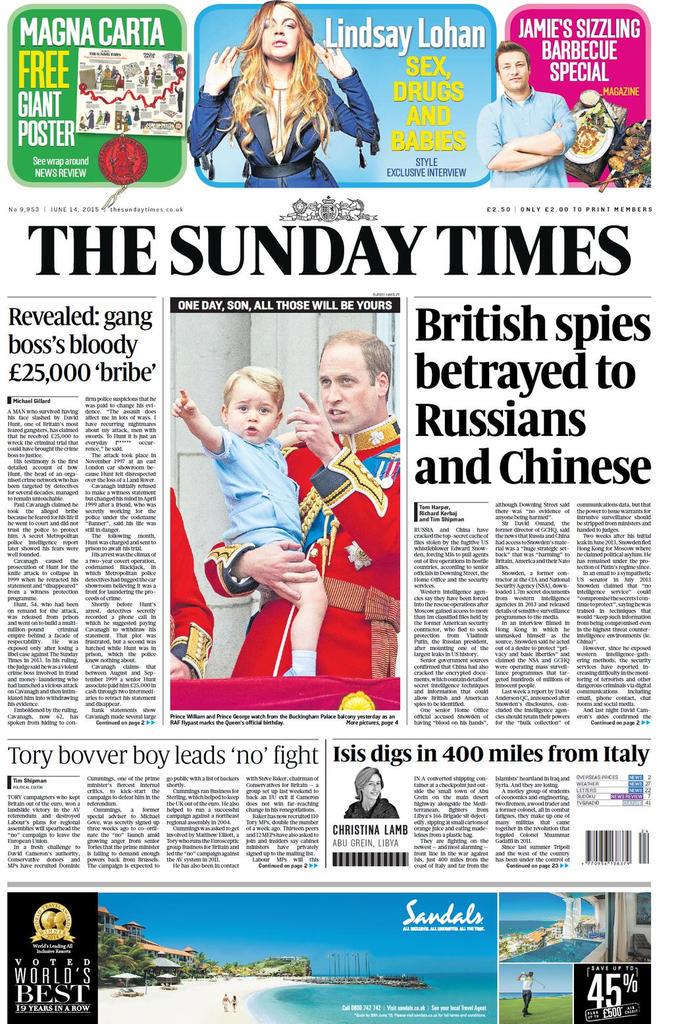
The Sunday Times has a front page story out today claiming that the Chinese and Russian governments have somehow managed to obtain National Security Agency whistleblower Edward Snowden's trove of documents. The story is sourced from anonymous UK government officials who make a series of significant allegations, unfortunately backed up with zero evidence. It's worth going through some of the key points of the story to cast some critical scrutiny on the central claims and to raise a few questions about them:
1) "RUSSIA and China have cracked the top-secret cache of files stolen by the fugitive US whistleblower Edward Snowden...according to senior officials in Downing Street, the Home Office and the security services."
Is the claim here that a full archive of encrypted files was "cracked" by some sort of brute-force decryption attack? If so, how did these "senior officials" establish that? How did the Russians and Chinese allegedly obtain the encrypted material in the first place?
2) "forcing MI6 to pull agents out of live operations in hostile countries."
This was a surprise to me because I've reviewed the Snowden documents and I've never seen anything in there naming active MI6 agents. Were the agents pulled out as a precautionary measure? Keeping in mind that the UK government does not actually know exactly what Snowden leaked, how do these officials know there were documents in there that implicated MI6 operatives and live operations in the first place?
3) "Moscow gained access to more than 1m classified files held by the former American security contractor"
Snowden has said repeatedly that he did not carry any files with him when he left Hong Kong for Moscow. Is this article alleging that he is lying? If so, where's the evidence to support that? Moreover, I've seen nothing in the region of 1m documents in the Snowden archive, so I don't know where that number has come from. Oh, wait:
4) "Snowden, a former contractor at the CIA and National Security Agency (NSA), downloaded 1.7m secret documents"
This 1.7m figure was invented by US officials and since then it has been regurgitated repeatedly and unquestioningly by various media outlets. I've seen the trove of documents; the claim or insinuation that he leaked 1.7m is not true.
5) "A senior Downing Street source said: 'It is the case that Russians and Chinese have information'."
Of course they do: the same information that the rest of the world has access to in public news reports and documents published as part of those. If the claim here is that the Russians and Chinese have access to every single document in the entire archive (i.e. all the unpublished material), where is the evidence to support that? How do the officials know? Are they speculating? These are serious claims — and serious claims demand serious evidence. Which is unfortunately not provided here.
6) “Why do you think Snowden ended up in Russia?” said a senior Home Office source. “Putin didn’t give him asylum for nothing."
I thought this one had long since been debunked by now, but apparently not. The reality is that Snowden never intended to stay in Russia. He was trying to get to Latin America and only ended up in Russia because his passport was revoked by the US government while he was transiting through.
7) Senior Home Office source: "His documents were encrypted but they weren’t completely secure and we have now seen our agents and assets being targeted.”
So the UK Home Office is alleging Snowden lied about taking documents to Moscow? How has it established that? And the "targeted" assets — how does the source know this has happened as a direct consequence of the Snowden leaks? There are many other factors at play here, and correlation does not imply causation. Especially with regard to Russia, given that anonymous UK "security sources" claimed months ago — again in the Sunday Times — that they are engaged in a "new Cold War" against Kremlin spies due to the broader issue of Vladimir Putin's heightened military posturing.
8) "A British intelligence source said: 'We know Russia and China have access to Snowden’s material'."
As I noted above: the Russians and Chinese have access to documents published with public news reports, sure, that's obvious and true. But is the claim here that they have access to material beyond that? If so, where's the evidence? How does this source "know" and what does he "know," exactly? Why the vague statement? Let's hear what it is the source knows and how so we can properly assess and scrutinise the merit of the allegation.
9) "It is not clear whether Russia and China stole Snowden’s data, or whether he voluntarily handed over his secret documents in order to remain at liberty in Hong Kong and Moscow."
If it's not clear then why does the top line of the story say the Chinese and Russians "cracked" the documents? If Snowden just handed them over, why would they need to "crack" them? And if the Russians and Chinese somehow stole the documents in encrypted form, how did they a) manage to obtain them in the first place (especially given Snowden says he didn't carry the files with him into Russia), and then b) break the encryption?
10) "David Miranda, the boyfriend of the Guardian journalist Glenn Greenwald, was seized at Heathrow in 2013 in possession of 58,000 'highly classified' intelligence documents after visiting Snowden in Moscow."
This is wrong. Miranda was detained at Heathrow after visiting Laura Poitras in Berlin. He wasn't visiting Snowden in Moscow and I think this is the first time I've ever seen this asserted. It's false.

*****

All in all, for me the Sunday Times story raises more questions than it answers, and more importantly it contains some pretty dubious claims, contradictions, and inaccuracies. The most astonishing thing about it is the total lack of scepticism it shows for these grand government assertions, made behind a veil of anonymity. This sort of credulous regurgitation of government statements is antithetical to good journalism.

The government has an obvious vested interest in portraying Snowden as a terrible person who's helped "the enemy" — it has been badly stung by his surveillance revelations and the political fallout that has ensued as a result of them. For that reason alone its claims should be treated with caution and not repeated unchallenged. Evidence should be necessary for allegations of this magnitude, which have such big ramifications. The Sunday Times has a long and commendable history of holding the government to account with great investigative journalism. But in this case, sadly, it has allowed itself to be used by faceless officials as a mouthpiece.

UPDATE, 14 June 2015, 19:30 BST: My colleague Glenn Greenwald has a post up at The Intercept dissecting the Sunday Times report, which he blasts as "pure stenography of the worst kind." Greenwald writes that "the exact kinds of accusations laundered in the Sunday Times today are made — and then disproven — in every case where someone leaks unflattering information about government officials." He says the story is "as shoddy and unreliable as it gets. Worse, its key accusations depend on retraction-level lies."

The Guardian has a good piece from Ewen MacAskill with five pertinent questions for the British government about the claims. "Anonymous sources are an unavoidable part of reporting, but neither Downing Street nor the Home Office should be allowed to hide behind anonymity in this case," writes MacAskill, who travelled with Greenwald and Laura Poitras to meet Snowden in Hong Kong back in 2013. "Where is the evidence?" he asks.

In another interesting development, the Sunday Times quietly deleted the false assertion I noted above (see #10) about David Miranda having documents on his possession "after visiting Snowden in Moscow." This has been removed from the online version of the story with no correction or note, but it can still be found in the paper version, which I got a copy of. The inaccuracy was significant as it underpinned the central dubious narrative of the story — that the documents were "held" by Snowden in Moscow, the insinuation being that this was how the Kremlin was supposed to have gotten hold of them, a claim presented in the story as unquestionable fact because nameless officials "confirmed" it (without offering any evidence).

UPDATE II, 15 June 2015, 19:00 BST: The lead reporter on the Sunday Times article, Tom Harper, has given an interview with CNN that has to be seen to be believed. In it, Harper is quizzed by host George Howell about the piece — and his answers highlight the many problems with the story's central allegations and how they were sourced. Here's a transcript of the important bits; I'll dissect some key points below.

Howell: How do senior officials at 10 Downing Street know that these files were breached?

Harper: Well, uhh, I don't know the answer to that George. All we know is that this is effectively the official position of the British government ... we picked up on it a while ago and we've been working on it and trying to stand it up through multiple sources, and when we approached the government late last week with our evidence, they confirmed effectively what you read today in the Sunday Times, so it's obviously allegations at the moment from our point of view and it's really for the British government to defend it.

How do they know what was in them [the files], if they were encrypted? Has the British government also gotten into these files?

Well, the files came from America and the UK, so they may already have known for some time what Snowden took — uhh, again, that's not something we're clear on ... we don't go into that level of detail in the story we just publish what we believe to be the position of the British government at the moment.

Your article asserts that it is not clear if the files were hacked or if he just gave these files over when he was in Hong Kong or Russia, so which is it?


Well again sorry to just repeat myself George, but we don't know so we haven't written that in the paper. It could be either, it could be another scenario ... when you're dealing with the world of intelligence there are so many unknowns and possibilities it's difficult to state anything with certainty and so we've been very careful to just stick to what we are able to substantiate.

The article mentions these MI6 agents ... were they directly under threat as a result of the information leaked or was this a precautionary measure?

Uhh, again, I'm afraid to disappoint you, we don't know ... there was a suggestion some of them may have been under threat but the statement from senior Downing Street sources suggests that no one has come to any harm, which is obviously a positive thing from the point of view of the West.

So essentially you are reporting what the government is saying, but as far as the evidence to substantiate it, you're not really able to comment or explain that at this point?

No. We picked up on the story a while back from an extremely well placed source in the Home Office. and picked up on trying to substantiate through various sources in various agencies throughout Britain, and finally presented the story to the government, and they effectively confirmed what you read in today's Sunday Times. But obviously when you're dealing with intelligence it's the toughest nut to crack and unless you have leaked documents like Snowden had, it's difficult to say anything with certainty.

So, in summary: How were the files breached? "I don't know." Were the files hacked or did Snowden hand them over? "We don't know." Were MI6 agents directly under threat? "We don't know." How did the government know what was in the files? "That's not something we're clear on." Can you substantiate the claims? "No."

The interview is quite extraordinary because it makes absolutely clear that not only was this entire dubious story based solely on claims made anonymously by government officials, the reporters who regurgitated the claims did not even seek to question the veracity of the information. They just credulously accepted the allegations and then printed them unquestioningly. That really is the definition of stenography journalism — it's shameful.

It's also worth noting that in Harper's interview he admits he has no idea how the Chinese and Russian governments supposedly obtained the files, yet the whole story was based on a bombshell claim that the trove of files was somehow "cracked" by Chinese and Russian government operatives (i.e. that the encryption on them was broken). As I noted above in point #9, if Snowden just handed over the files, why would these governments then need to "crack" them, unless the claim is that he handed over a set of encrypted documents? Either way, Harper says he has no idea how the files were obtained, so how does he know they were "cracked"? This central allegation seems to have been invented completely out of thin air, at worst a fabrication by technologically inept reporters who don't understand what terminology like "cracked" means, at best derived from evidence-free conjecture from spineless government officials too afraid to put their names to the claims.

It is also very telling to note that Harper cites "an extremely well placed source in the Home Office" as the initial person who tipped him off about the story. That's presumably the same "senior Home Office source" quoted in the story insinuating that Snowden chose to go to Russia and hand over documents in return for asylum. That absurd allegation, as I noted in point #6 above, contradicts the fact that Snowden only ended up in Moscow because the US government foolishly revoked his passport and stranded him there while he was passing through on route to Latin America; moreover, Snowden has said repeatedly that he didn't take any documents to Russia. Any reporter familiar with the story knows this. An assertion from an official claiming Snowden went there to hand over documents should surely have set off alarm bells about the credibility of his claims, and should have at least prompted a demand for evidence to back them up, given their magnitude.

But no alarm bells were triggered in our boy Harper's head. Sounding more like a government press officer than a journalist, he told CNN: "we just publish what we believe to be the position of the British government at the moment."

And that brings me to my final point on this. Harper claimed in his CNN interview that his story was "effectively the official position of the British government." If that's the case, then why will no one in the government come out and say so publicly? As the well-sourced BBC security correspondent Gordon Corera noted in a measured analysis on Sunday: "No one in government today is confirming that they are sure that the Russians and Chinese have got full access — that remains in the realm of 'no comment'."

Snowden's Fate

Monday, 17 June 2013

On Democracy Now today there was an insightful interview with Hong Kong legislator Charles Mok on the potential next steps for US National Security Agency whistleblower Edward Snowden.

Snowden is currently believed to be in Hong Kong after passing a batch of NSA documents revealing top-secret surveillance programs to the Guardian, the Washington Post, and the South China Morning Post. US authorities have initiated a criminal investigation over the leaks and will probably pursue Snowden's extradition in the weeks and months ahead.

Mok talks about what that process could entail, and says that though Hong Kong enjoys independence from mainland China on many issues, the international magnitude of the Snowden case means the final decision that will determine his fate is ultimately likely to be made by central government in Beijing:

Please understand that at least we have a one-country, two-system system in Hong Kong and between Hong Kong and the mainland. So our laws are different from the laws in China. And we do have a border and so on. We do have different governments, even though as a regional government, we do report to the central government.

So I think what we want locally is to make sure that we can protect [Snowden] and make sure that we can live up to our core values and make sure that we treat this person according to all the rights that he should be getting under Hong Kong law. And... exactly what I don’t want to see, is that this sort of political influence to be interfering into the justice process, the judicial process that Mr. Snowden may end up having to get in Hong Kong. If, for example, the US starts by contacting the Hong Kong government to try to initiate an extradition, and if Mr. Snowden decides to try to get asylum or apply for refugee status here in Hong Kong, he — if he chose to do that, if the process comes to that point, he should be getting all the rights. [...]

If the US started to initiate a process [to] say that we want to arrest this person and start an extradition process, then Mr. Snowden could apply in Hong Kong for refugee status. And then there would be at least two tests: first by the United Nations High Commission on Refugees to determine whether or not, for example, that he will face torture at home and whether or not this is political persecution and so on, and second, also by the Hong Kong court. [...]

He will be accorded rights to appeal all the way up to our highest court in Hong Kong. So, assuming that money and financial issues — because you do need to get lawyers and so on — assuming those are not an issue, these processes in the past could have taken quite a bit of time. But... if [Snowden] isn’t successful and there has to be a final decision to be made about the extradition, our chief executive in Hong Kong, which is pretty much [like] our president... he will have to make the final decision. But because this case very likely will involve foreign relations, then he has to consult the central government. So, in the end, it means that the process can be a pretty prolonged process, and, second, Beijing will probably come into the equation to make a final decision in the end.

You can watch the full interview here.