Showing posts with label wikileaks. Show all posts

WikiLeaks-Trump timeline

Tuesday, 31 July 2018

I put together a short timeline comparing WikiLeaks' public statements on Trump with its leaked private comments on him. Useful for anybody trying to keep track of all the duplicity that's going on:

**

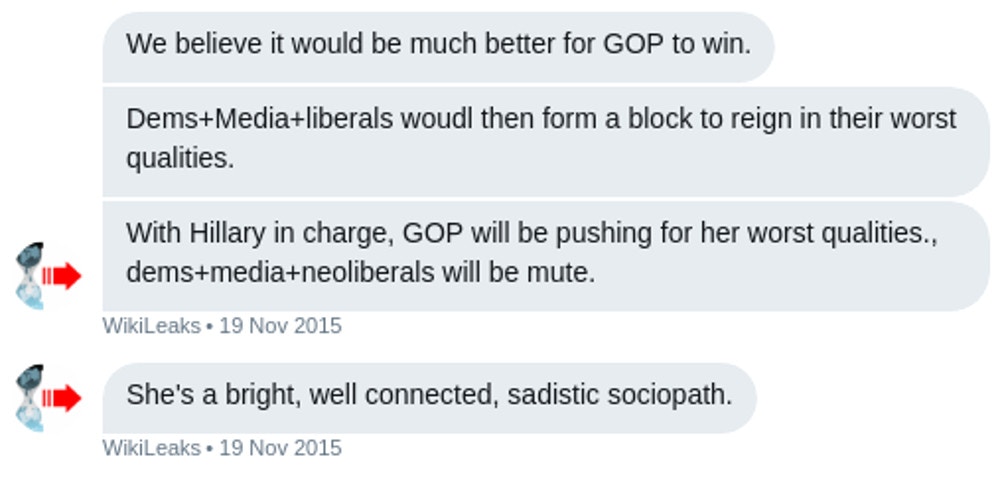
Privately, 19 Nov 2015: WikiLeaks says "we believe it would be much better for GOP to win." Calls Clinton a "well connected, sadistic sociopath." (Source: copy of DMs - via The Intercept. Note: I personally verified the authenticity of these DMs.)

Publicly, 26 Aug 2016: Assange appears on Fox & Friends and says "We do have some information about the Republican campaign" but suggests he won't publish it because "it’s actually hard for us to publish much more controversial material than what comes out of Donald Trump’s mouth every second day." (The material is never disclosed.)

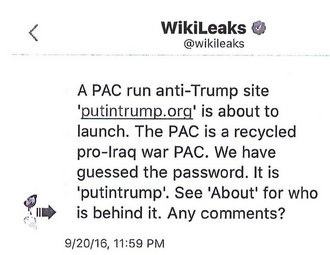
Privately, 20 Sept 2016: WikiLeaks sends Donald J Trump Jr a password to an anti-Trump website which it claims to have "guessed." (Source: Twitter DMs - copies released by Donald J Trump Jr.)

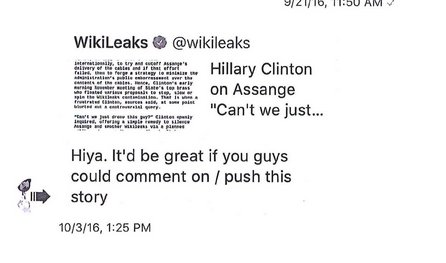
Privately, 3 Oct 2016: WikiLeaks asks Donald J Trump Jr to "push" a dubiously sourced story from a conservative website called "True Pundit" alleging Hillary Clinton wanted to kill Assange with a drone. (Source: Twitter DMs - copies released by Donald J Trump Jr.)

Publicly, 7 Oct 2016: The Washington Post, at about 4pm US Eastern Time, publishes a now infamous video recording in which Donald Trump can be heard boasting about grabbing women's genitals. Within an hour, WikiLeaks publishes an email leak from Hillary Clinton's campaign chair, John Podesta. (Source: Politifact.)

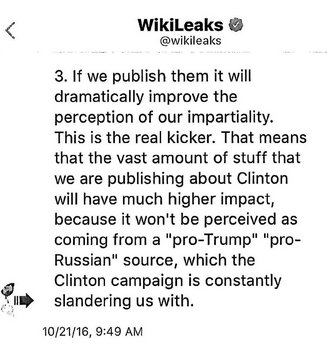
Privately, 21 Oct 2016: WikiLeaks asks Trump Jr to let it publish copies of his father Donald Trump's tax returns because it says doing so would "dramatically improve the perception of our impartiality" & get "much higher impact" for "the vast amount of stuff that we are publishing about Clinton." (Source: Twitter DMs - copies released by Donald J Trump Jr.)

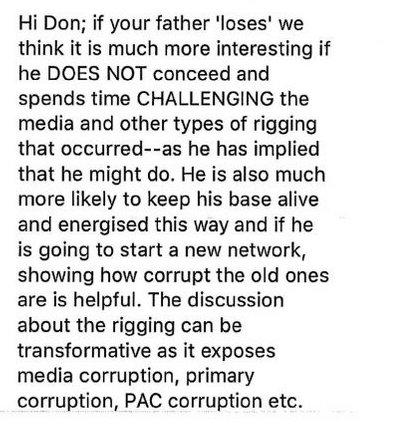
Privately, 8 Nov 2016 (day of the election, before results announced): WikiLeaks advises Donald J Trump Jr that Donald Trump shouldn't concede the election if he loses & instead should blame "rigging" and "media corruption" to "keep his base alive." (Source: Twitter DMs - copies released by Donald J Trump Jr.)

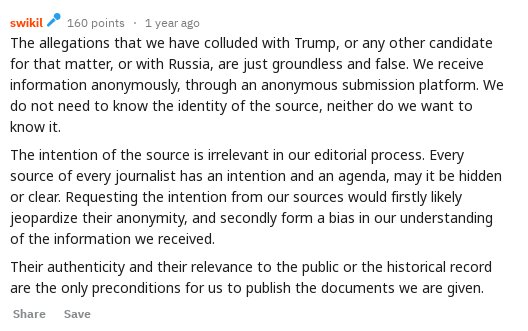
Publicly, 10 Nov 2016 (after Trump election victory announced): WikiLeaks claims in a Reddit AMA that "allegations that we have colluded with Trump, or any other candidate for that matter...are just groundless and false." (Source: Reddit.)

Publicly, 10 Nov 2016: WikiLeaks claims in a Reddit AMA that "we were not publishing with a goal to get any specific candidate elected." Claims it did not "editorially back one candidate over another." (Source: Reddit.)

Publicly, 10 Nov 2016: WikiLeaks says in a Reddit AMA that it has "not received information on Donald Trump’s campaign." (Three months earlier, on 26 Aug 2016, Assange said "We do have some information about the Republican campaign" - see above.) (Source: Reddit.)

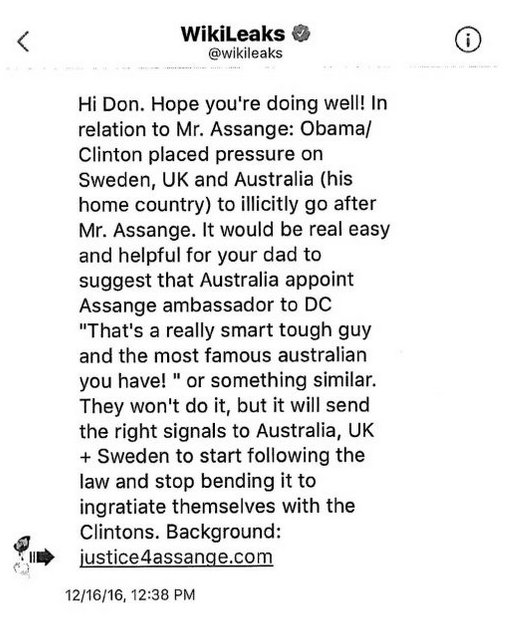
Privately, 16 Dec 2016: WikiLeaks asks Donald J Trump Jr to get Donald Trump to pressure Australia to "appoint Assange ambassador to DC" because he is a "really smart tough guy." (Source: Twitter DMs - copies released by Donald J Trump Jr.)

Publicly, 14 Jan 2017: WikiLeaks denies Assange is trying to endear himself to Trump, claims it's just "using Trump aligned media to amplify its publications and critiques of secrecy and war." (Source: Twitter.)

**

(The Donald J Trump Jr private messages were first disclosed in Nov 2017; the original source material can be found in three parts, here, here, and here. The other referenced private messages were first disclosed in Feb 2018 by my colleagues at The Intercept - the full archive of 11,000 private messages were released this week by activist Emma Best and can be found here. This is only a partial analysis; it is not comprehensive. There's a lot more information out there. I may add to this timeline once I have reviewed other material.)

Sabu, LulzSec, and the FBI's WikiLeaks Investigation

Monday, 26 May 2014

Some very intriguing new details emerged on Friday about the case of former Anonymous hacker turned FBI informant Hector Monsegur, or "Sabu" as he is better known.

A document filed in a New York district court shed light on the "extraordinarily valuable and productive" extent of Sabu's cooperation with the government over a period of approximately three years.

It is already widely known that Sabu secretly helped authorities track down and jail his former hacker comrades who were part of LulzSec, a high-profile Anonymous splinter group that attacked and infiltrated major corporate and government websites in the summer of 2011.

But the latest court document for the first time hints at Sabu's broader role aiding another major FBI undercover operation — one that I believe likely relates to an aggressive investigation into WikiLeaks and its founder Julian Assange. The section of the document in question is vague, deliberately so, but offers enough detail to indicate that it directly involves WikiLeaks and is potentially of high importance, for reasons I'll explain below. The document states:

Monsegur also engaged in a significant undercover operation in an existing investigation through which, acting at the direction of law enforcement, Monsegur gathered evidence that exposed a particular subject’s role in soliciting cyber attacks on a foreign government. The evidence he enabled the Government to obtain was extremely valuable, and the Government could not otherwise have obtained it without his assistance. Although this cooperation has not resulted in any prosecutions to date, the Government believes his information, and the evidence he helped to obtain in this matter, is extremely significant.

To understand why this matters and why it struck me straight away, a bit of background is necessary.

As I reported last year in a piece for Slate, Sabu, while working as an FBI informant in 2011, was in contact with a young WikiLeaks volunteer who had established a close relationship with Assange.

The volunteer, Sigurdur Thordarson, told me that with Assange's approval he set up a line of communication between Sabu, LulzSec, and WikiLeaks. He said he then solicited the hackers to infiltrate computers at the Icelandic Ministry of Finance to find evidence of anti-WikiLeaks sentiment. "That was the first assignment WikiLeaks gave to LulzSec," Thordarson claimed, because the Ministry of Finance had months earlier thwarted an attempt by DataCell, a company that processes WikiLeaks donations, to purchase a large new data center in Reykyavik. The FBI appears to have monitored the exchange between WikiLeaks and LulzSec through Sabu, and a few days later contacted Icelandic authorities to warn them about an imminent cyber attack. Icelandic police travelled to the United States to discuss the matter, according to information published by the country's state prosecutor.

According to Thordarson, the LulzSec hackers eventually turned over some confidential documents to WikiLeaks that related to the US embassy in Iceland, as well as other hacked files, such as a huge trove of emails mined from Syrian government servers that were later released by WikiLeaks. Thordarson alleged that Assange spoke with Sabu over Skype during this time, and he showed me records of chats he had with Sabu that appear to support his version of events. Again, Sabu was secretly working as an FBI informant during his correspondence with WikiLeaks; FBI agents, who were monitoring Sabu's online activity 24/7 and directing his conduct, would have almost certainly been watching over his shoulder during any conversations with Assange or others.

In a bizarre twist, Thordarson himself later became an FBI informant, before he found out that Sabu, too, was working for the Bureau. (You can read the whole crazy backstory here.) WikiLeaks says Thordarson was a rogue operative and has accused the FBI of using "coercion and payments" in an effort to extract information that could be used against its staff in a prosecution. It is unclear whether Assange was personally involved at all in any attempt to solicit the hacking of foreign government computers.

Either way, one thing that is clear and undisputed is that Sabu was in contact with WikiLeaks while he was working for the FBI. And the new court document in Sabu's case strongly suggests to me that the contact was not some random occurrence — rather, it suggests it was part of a concerted FBI undercover sting operation aimed at implicating Assange and his colleagues in criminal activity.

The mention of "a particular subject’s role in soliciting cyber attacks on a foreign government" stood out to me immediately as a likely reference to the Assange-Thordarson-Sabu-Iceland affair, perhaps even intended as a warning shot from the Justice Department that this is an angle still being pursued. WikiLeaks seems to have noticed it, as well, tweeting on Saturday that the document contained an "apparent reference to [an] FBI operation against WL."

It is worth recalling that the FBI and the Justice Dept. still have an active and ongoing criminal investigation into WikiLeaks, a fact that was most recently confirmed just last week. But because of constitutional press freedom protections in the United States under the First Amendment, to prosecute any WikiLeaks staff for their role in publishing leaked classified US government documents would be untenable. That is precisely why it is far more likely that the FBI will be seeking to find other charges it can lay against Assange, such as conspiracy, and that is where I think Sabu comes into the frame. The new court document refers to an "existing investigation" and notes that while the information Sabu gleaned about the cyber attacks being solicited "has not resulted in any prosecutions to date," it remains "extremely significant." [Emphasis added.]

So watch this space. I expect more details about this dramatic debacle are going surface before long — possibly even in an indictment against Assange, if the FBI gets its way.

The Chenagai Madrassa Incident

Tuesday, 23 July 2013

On 30 October 2006, an Islamic school in Pakistan was targeted in a missile strike that killed up to 81 people, most of whom were reportedly children, some as young as seven.

At the time of the strike, which took place in the town of Chenagai in the tribal area of Bajaur, Pakistan's military claimed responsibility, saying it had targeted the school — known as a madrassa — because it was being used as a terrorist training facility. However, an anonymous former Pakistan official, described as an ex-"key aide" to then-President Pervez Musharraf, later reportedly claimed that the attack had been carried out by a US drone, according to the Sunday Times. The US denied any role, saying it was "completely done by the Pakistani military."

Now, a newly published report has raised fresh questions about exactly who was behind this horrific incident. A leaked Pakistan government document, published by London's Bureau of Investigative Journalism on Monday, lists the Bajaur case among a series of US Predator drone strikes and NATO-backed attacks in Pakistan between 2006 and 2009. The Bureau says that the document shows the attack was the result of "a single drone strike," though the document does not specify whether a drone or other aircraft was involved.

So who carried out this controversial attack?

At the time of the strike, Pakistan's army spokesman said that it had been carried out by Pakistan military helicopter gunships that fired four or five missiles into the madrassa. One local villager told the BBC he had "heard helicopters flying in and then heard bombs." An NBC news correspondent, who was reportedly about a mile away from the madrassa at the time of the incident, said that it "was dark and very early in the morning when the blast occurred. And then I heard helicopters over the village of Chenagai where the madrassa school is located."

Analysts speculated that Pakistan's military may have not had the skills required to conduct the helicopter strike, because it was apparently conducted at 5am while it was still dark and had the hallmarks of an elite operation. Hours after the attack, Bill Roggio at the Long War Journal suggested that a US special operations team may have been behind it. "Look for signs of Task Force 145 having carried out this raid," Roggio wrote, "with unmanned Predators firing Hellfire missiles, and possibly C-130 and helicopters following up."

Others had an alternative theory. On October 31, 2006, Syed Saleem Shahzad at the Asia Times wrote:

Recently, Islamabad agreed with NATO that it could conduct operations in Pakistan from across the border in Afghanistan... Significantly, Pakistan and Taliban authorities struck a peace deal in Bajour only two days ago and were scheduled to sign a document to that effect on Monday. This lends credence to the possibility that it was NATO and not Pakistani forces that made the raid.

Among those who died in the attack was the leader of the madrassa, a reportedly pro-Taliban radical cleric named Maulana Liaqat. Pakistan officials also claimed that Ayman al-Zawahiri — who was then Osama bin Laden's deputy — had used the madrassa to train suicide bombers. That would certainly have given both US and NATO forces a motive to want to target the building. And Pakistan has covered up for US drone strikes in the past.

But still, there is still no concrete information that has been presented confirming beyond doubt that a US drone or any other US or NATO military aircraft was involved.

Indeed, secret US diplomatic cables published by WikiLeaks in 2010, four years after the strike, did not hint at any US or NATO role. US officials writing in classified cables dated from 2006 described the incident alternately as a "Pakistan military strike against a madrassa/militant training camp" and a "Pak-Mil attack on an extremist madrassa."

Even with the Bureau of Investigative Journalism's publication of the leaked Pakistani document attributing the attack to NATO forces or a US drone, in my view, the facts remain murky and contentious. And that is perhaps one of the most shocking elements of this story — that seven years on there is still such a lack of clarity about the circumstances of this grave incident, involving the reported deaths of dozens of innocent children.

Without an answer to such a simple question — who pulled the trigger? — there can be no accountability, no closure, no recourse for justice for the families of those who lost a child on that day in Chenagai. It is an incident that seems to symbolise the bloody, faceless brutality of the ruthless covert warfare that has become a staple feature of the so-called War on Terror over the past decade, especially in the tribal regions of Pakistan. But just because there may be dangerous, high-level terror targets operating in these places, military forces, wherever they are from, should not get a pass to kill and maim with impunity. For that reason alone, the madrassa strike surely requires serious further scrutiny — perhaps from UN special rapporteur Ben Emmerson, who is currently investigating the issue of civilian drone deaths.

The WikiLeaks Grand Jury

Thursday, 28 March 2013

As Alexa O'Brien reported Tuesday, the US Department of Justice has provided the latest confirmation that the grand jury investigation into WikiLeaks remains currently ongoing. That means it has been actively investigating the whistleblower website now for at least about 26 months (the Guardian first reported back in January 2011 that a subpoena seeking data on WikiLeaks had "appear[ed] to confirm for the first time the existence of a secret grand jury" empanelled to investigate individuals associated with the organisation. Prior to that, in late November 2010, the White House confirmed that there was an "active, ongoing criminal investigation" into WikiLeaks. And in July 2010, the Department of Defence stated that it had requested that the FBI help with an investigation related to WikiLeaks disclosures and that it "go wherever it needs to go").

I've been doing a bit of reading on grand juries, and the time-frame is significant because they do not have an indefinite lifespan. US law states that:
The grand jury shall serve for a term of eighteen months unless an order for its discharge is entered earlier by the court upon a determination of the grand jury by majority vote that its business has been completed. If, at the end of such term or any extension thereof, the district court determines the business of the grand jury has not been completed, the court may enter an order extending such term for an additional period of six months. No special grand jury term so extended shall exceed thirty-six months, except as provided in subsection (e) of section 3333 of this chapter.

From subsection (e) section 3333:

A special grand jury term may be extended by the district court beyond thirty-six months in order that such additional testimony may be taken or the provisions of subsection (b) of this section may be met.

And this from the American Bar Association's riveting Handbook on Antitrust Grand Jury Investigations:

The district court may extend the term of the special grand jury to a total of 36 months... The special grand jury may continue even beyond 36 months if it issues a report, and if the district judge determines that additional testimony is necessary, or that the report needs to be rewritten to comply with the governing statute.

So this means that the WikiLeaks grand jury seems to have been granted at least one six month extension thus far, as it has definitely exceeded the 18 month period already. It also suggests that some time between July this year and January 2014 — about four to ten months from now — the grand jury will either have already wrapped up or it will be close to wrapping up as it reaches the somewhat flexible 36-month cut-off point (see an update on this below). Grand juries, for those unfamiliar with them, do not decide the guilt of a person or persons. What they do is take evidence and make a judgement on whether or not criminal charges can be brought (in the form of an indictment) — in this case against Julian Assange and others affiliated with WikiLeaks.

All things considered, I would expect that within the next year or so it will be crunch time for this long-drawn-out saga. It still seems as if it could swing either way at this point, but it is worth weighing up the influence the broader political climate may have. There is an atmosphere in the United States at the minute that seems to represent a growing fatigue with the punitive national security culture that became pervasive post 9/11. Recent court judgments have gone against the government on issues related to secret surveillance and covert drone strikes, and this makes me wonder whether the tides are changing — albeit only incrementally and to a small degree.

Choosing to prosecute Assange for his role as an editor in publishing classified documents, as if it needs to be said, would be an outrageous decision that would cause an almighty outcry from a cross-partisan range of organisations and in the process damage the standing of the United States globally. Even at the height of the Bush administration's jingoistic reign it would have been an extremely controversial call to make. So for Obama's Justice Department to pursue a prosecution in the months ahead, in an atmosphere that may be tangibly shifting against draconian policies, would be a doubly contentious act that could turn out to be politically kamikaze for Obama personally in terms of his lasting legacy. All of these things will surely factor into any final decision regarding a prosecution, which will no doubt be discussed at the very highest echelons of the administration. But first, of course, we will have to wait to see whether or not the grand jury determines that there are charges to pursue in the first place....

*****

UPDATE, 1 April 2013: Wired.com news editor Kevin Poulsen, who was himself once the subject of a grand jury investigation for hacking into computer systems, tells me: "When a grand jury is up, prosecutors can just roll the case into a new grand jury." Significantly, this means that the 36-month cut-off point is far more flexible than the law I cited above implies, because when the first grand jury runs out of time, a new, second grand jury can effectively take up the investigation and continue its work with a fresh timetable. Poulsen said this occurred in his own case ("I had two GJs in series. Prosecution had a law enforcement witness summarize all previous testimony for the incoming panel"). And the book Grand Jury Practice by Howard W. Goldstein suggests it is not an unusual occurrence. Goldstein notes that "given the increasing complexity of federal investigations, many are not finished before the grand jury's term expires," adding: "information developed in one grand jury may be relevant to another grand jury."

An additional point worth mentioning here is that, according to an analysis of grand jury statistics circulated by WikiLeaks:

it is extremely rare for a grand jury not to indict. In the year 2009, federal grand juries in the United States saw cases involving 69,245 suspects and voted to indict all but 20 of them. (This is denoted by "no true bill returned" in the document.) That is a approximately one in every three thousand five hundred suspects. These statistics are repeated year after year. Given that it is known that he is the target of a grand jury investigation, Julian Assange has in and around a 99.97% chance of being indicted.
Interestingly, the same statistics show that US attorneys declined to prosecute 29,780 suspects in 2009 for reasons such as "stale case," "weak evidence," "minimal federal interest," and "Department of Justice policy." These all sound like strong grounds to halt any future attempt to prosecute WikiLeaks staff for their publishing work — if and when an indictment eventually materialises.

The Rise of Public Relations and The Great Wall of Obfuscation

Friday, 16 November 2012

It's a well established fact that the growing public relations industry is having a profound impact on journalism today. Last month I was reading about how global PR revenues are amounting to $10bn a year, and in the United States it is estimated that the ratio of American PR professionals to journalists grew from 1.2-1 in 1980 to 4-1 in 2010.

What this means in reality is not only that journalists are ceaselessly bombarded by a near-constant flow of emailed press releases. It has also contributed towards something far more damaging to the profession. That is, how public relations representatives and press officers increasingly function as a barrier or buffer between the journalist and the information he (or she) wants to obtain. They often seem trained to engage in evasiveness, less interested in helping reporters reveal information than they are in protecting the reputation of the organisation which pays their salary.

I'll cite a few routine examples just to illustrate the sort of thing I'm talking about.

1. I have been chasing a well-known US technology company for more than two months about an important story I have been working on concerning surveillance, and so far I have been passed between two separate public relations teams. Both have evaded answering my direct questions and declined to put me in direct contact with the people at the company I need to speak to. Why? "It's complicated," I have been repeatedly told.

2. Government organisations are just as bad. Only last week I discovered that the European Commission, the EU's executive body, has a rule in place that bars its officials from talking directly to any journalists. Any contact, one official told me, has to be approved by the press office, which functions as a sort of overlord, sanctioning any comments before they are released.

3. While pursuing a story last year about Bradley Manning, the US soldier accused of leaking US government documents to WikiLeaks, I contacted a police detective in Wales who I understood had some involvement in the Manning case. Manning is a joint UK-US citizen because his mother is Welsh and lives in Wales, and I wanted to find out more information about claims the Welsh force had assisted the FBI to search his mother's house. The detective refused point blank to speak with me when I called her on the phone; she sounded offended that I had even attempted to ask her a question directly and hung up on me seconds after I introduced myself. The press officer for the force swiftly emailed me a reprimand: "In future if you have a media query please observe the correct protocol and contact the press office and do not approach individual officers directly." I fired back: "Not every public body – police force, council, government office etc. – has a set in stone 'protocol' that must be blindly adhered to and never breached. May I remind you that it is not a against any law for a journalist to approach a police officer to ask for background comment."

The cold and arbitrary bureaucracy of it can be extremely frustrating. On some occasions, press officers can be helpful: assisting you by pointing out relevant information, or by arranging interviews with officials. But in other (most) cases there is no doubt that they function as corporate-style risk managers ready to erect a Great Wall of Obfuscation the moment they get a whiff of a controversial headline.

This also has a bearing on the UK's Freedom of Information Act, which is used to obtain information from public bodies. Specifically, take how London's Metropolitan Police has admitted handling Freedom of Information requests. FOI requests, according to the UK's Information Commissioner, are supposed to be "applicant and motive blind" because "it is about disclosure to the public, and public interests. It is not about specified individuals or private interests." The Met's policy, revealed during a government consultation on FOI law in February, contravenes the commissioner's principle because journalists' requests are treated differently and have to be pre-approved for release by the press office.

One thing I am glad to see is that the UK's Society of Editors appears to have recognised the impact all of this is having. On Monday in Belfast the Society hosted a discussion on the topic, described as follows:

Members of the public have a right to know, but journalists are finding it increasingly difficult to get answers to the simplest of questions on their behalf. A creeping control culture means that face-to-face contact, and even telephone calls being replaced by carefully managed email exchanges. De-humanised, sterile, and obstructive, this trend poses a serious threat to journalism and genuine transparency – at all levels.

It is definitley a threat – but I'm not sure how journalists collectively can respond. As the public relations industry grows, in stark contrast, journalism is struggling to survive. There are less and less publications out there able to invest in time-consuming, laborious investigative reporting, which is hugely detrimental to society and to the health of democracy.

One solution might be for the government to create a kind of investigative journalism fund to help reporters and media outlets finance important investigative projects. This has been supported by a House of Lords committee – but is probably unlikely to come to fruition at least in the near future due to the wider economic crisis. Yet it's not as if public funding for investigative reporting isn't financially viable, even in the grip of a recession. Recently, the government wasted an estimated £40 million on a botched rail contract. Yes, £40 million. Even a fraction of that amount could have funded valuable muckraking projects and helped to push back against the polluting culture of public relations.